How Retained Reflexes Are Driving Your Child’s Gut Issues, Behavior & Feeding Struggles
Primitive reflex patterns may be a new phrase for you. You may have heard it from your mom social pages or maybe you’ve heard it from your pediatric therapists. Primitive reflexes are automatic, involuntary movement patterns that originate in the brainstem. They're present from birth, and even in utero, and they serve critical survival functions in a baby's early life: rooting for food, startling in response to threat, building the muscle tone and coordination needed for movement and development.
In typical neurodevelopment, these reflexes are gradually inhibited and integrated (disappear), usually within the first year or two of life, as higher brain centers come online and take over regulation. When this process goes well, the child develops emotional regulation, coordinated movement, focused attention, healthy digestion, and the capacity for learning.
But when a reflex doesn't fully integrate—due to birth trauma, stress in utero, illness, limited floor time, or developmental interruption — it stays active in the nervous system past its developmental window. This is what we call a retained primitive reflex.
The gut, the nervous system, the reflex patterns, the body's biochemistry — these are NOT separate systems. You cannot address one and ignore the others. This is exactly why I have specialties in all of these areas—because they all go together. And at the center of it all, for so many of the children I work with, is a root cause that conventional care rarely checks: retained primitive reflexes.
From an OT lens, we see how this shows up in sensory processing, motor coordination, and daily function. From a reflex specialist perspective, we understand exactly which reflex is active, how it's firing, and what movement patterns can help the nervous system complete what was left undone. And from a functional health standpoint, we look at what's happening in the body's biochemistry — gut inflammation, nutrient depletion, nervous system load — that may be keeping those reflexes locked in place.
All three views are necessary. None of them alone is enough.
The gut–reflex connection nobody is talking about
Here's something that often surprises parents: your child's gut issues and their nervous system are not separate problems. They are expressions of the same underlying dysregulation.
The gut and brain are connected via the vagus nerve and the enteric nervous system — sometimes called the "second brain." When primitive reflexes remain active, the nervous system stays in a state of sympathetic dominance, a low-grade survival mode, which directly suppresses digestive function. Gut motility slows. Enzyme production drops. The gut lining becomes more permeable. The microbiome shifts toward dysbiosis.
From a functional health lens, we often see this show up as: chronic constipation, gut pain & bloating, slow motility, reflux & vomiting.
What makes the functional health lens so important here is that we're also asking: what nutritional depletions are making the nervous system less resilient? What gut or neuro inflammation is affecting the body’s ability to heal? What's in the child's biochemical terrain that needs to be addressed alongside the reflex work — because one without the other will only go so far.
Many of the children I work with have had extensive GI workups — scopes, panels, allergy testing — with inconclusive results. When we address the nervous system state alongside gut support, digestion often begins to regulate in ways no isolated gut protocol could achieve alone.
Retained reflexes and behavior: your child is not giving you a hard time — they're having one
This is the piece I am most passionate about communicating to parents, educators, and other practitioners: a child with retained primitive reflexes is not choosing their behavior. Their brainstem is generating automatic survival responses that their higher brain centers do not yet have the neurological connections to override.
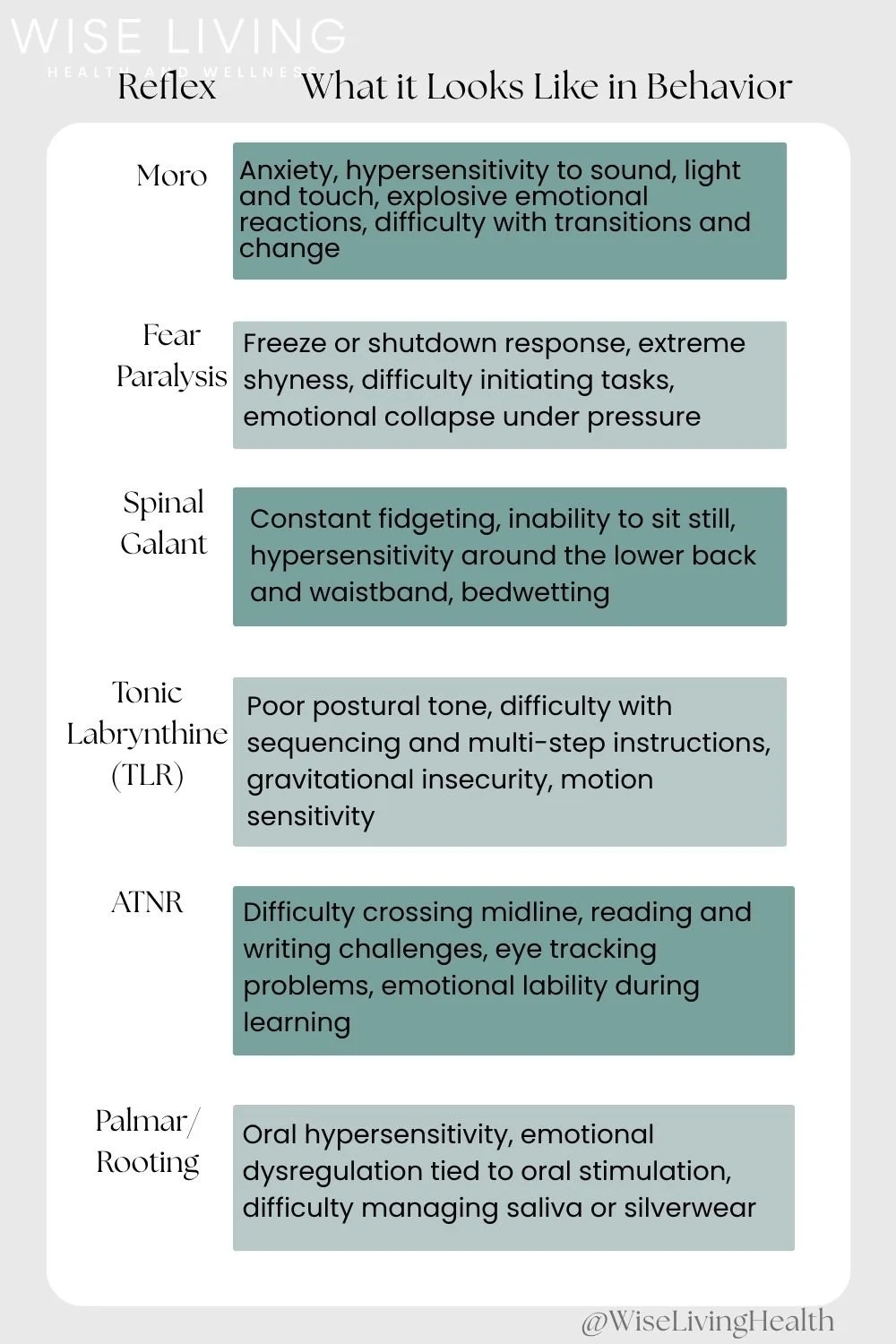
From an OT perspective, we see how sensory processing difficulties amplify behavioral dysregulation. From a reflex specialist lens, we can identify exactly which reflex pattern is driving the behavior and what's needed to help the nervous system mature past it. And from a functional health standpoint, we know that nutrient deficiencies significantly reduce the nervous system's capacity for function & regulation.
Feeding struggles: when the body experiences eating as a threat
Feeding difficulties are where the three lenses of my practice converge most visibly — because a child who struggles to eat is showing us something about their nervous system, their reflex patterns, their sensory processing, and often their gut health, all at once.
In early infancy, several reflexes drive feeding: the rooting reflex, sucking reflex, swallowing reflex, and the Babkin reflex (which links hand pressure to mouth opening). These are brilliant in a newborn. But when they remain active past their developmental window, they create real, physical barriers to comfortable eating:
A hyperactive gag reflex that fires on texture, smell, or even visual presentation of food
Tongue thrust patterns that interfere with chewing and swallowing mechanics
Oral hypersensitivity making new foods feel genuinely threatening or painful
Poor jaw stability and core support linked to TLR retention, making chewing effortful and tiring
Food restriction driven not by preference but by nervous system self-protection
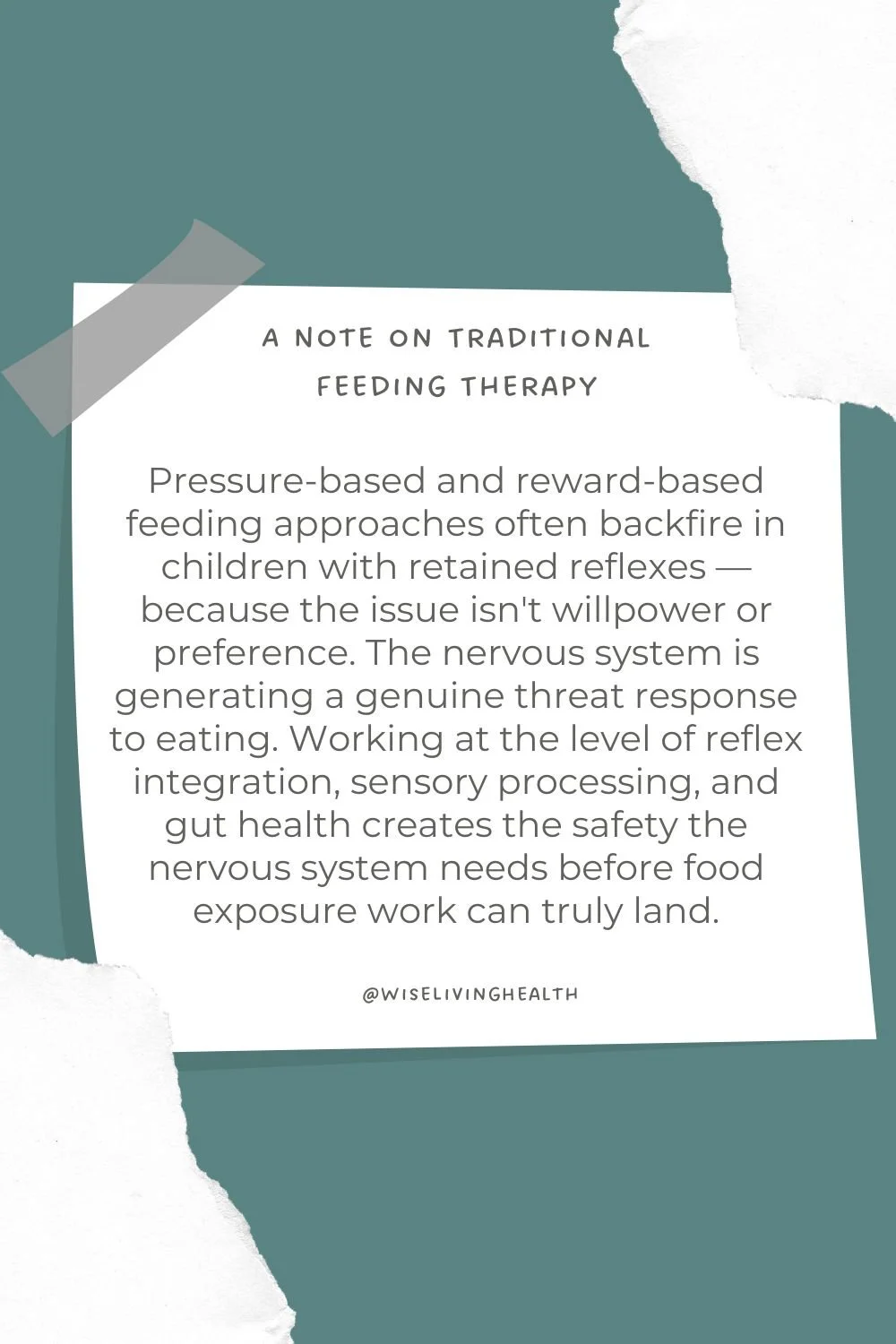
As an OT, I'm looking at the sensory and motor underpinnings of the feeding difficulty.
As a reflex specialist, I'm working with the specific reflex patterns keeping the oral system in a defensive state.
And as a functional health practitioner, I'm asking: is there gut inflammation that's amplifying oral sensitivity? Are there nutrient gaps making the nervous system less tolerant? Is the microbiome contributing to heightened visceral and sensory reactivity?
But combining the three—I’m focusing on bringing safety to the child’s nervous system in order to move forward.
Why one lens is never enough — and what integrated support actually looks like
This is the heart of why I practice the way I do. I spent years in traditional OT practice watching children make progress (or not at all) — and then plateau. I watched functional health practitioners get results that didn’t hold because the nervous system wasn't ready to receive them. I watched reflex integration work move slowly because the biochemical terrain was too depleted or inflamed to allow the nervous system to change efficiently.
When you bring all three lenses together, something different becomes possible.
In practice, this means a child who comes to me with constipation, meltdowns, and food refusal isn't just getting reflex exercises or a gut protocol or a sensory diet in isolation. We're looking at the whole picture: which reflexes are retained, what the gut terrain looks like, what the nervous system needs biochemically, and what sensory and functional supports will create the conditions for real, lasting change.
This is not a faster approach. But it is a deeper one — and for the families who've been trying partial solutions for years, depth is exactly what's needed.
Comprehensive neurodevelopmental assessment — identifying which reflexes are retained and how they're showing up across gut, behavior, and feeding
Functional health evaluation — gut health markers, nutrient status, inflammatory load, and what the biochemical terrain needs to support nervous system change
OT-informed sensory and functional mapping — understanding the child's daily experience and what will reduce their overall nervous system load while the deeper work unfolds
Guided reflex integration — gentle movement protocols tailored to the child's specific reflex profile, with a home program families can embed into daily life
Ongoing reassessment across all three lenses — because these systems are dynamic, and the support evolves as the child does

The bottom line
Your child's gut issues, behavioral challenges, and feeding struggles are connected. They are not random, and they are not a parenting failure. And in the vast majority of cases I see, they share a common root: a nervous system that needs to be given the conditions to fully develop and integrate.
Retained primitive reflexes are among the most underrecognized drivers of these challenges and they sit at the intersection of everything: sensory processing, digestive function, emotional regulation, feeding mechanics, and learning. When we address them through the combined lens of reflex integration, occupational therapy, and functional health, we're not managing symptoms. We're building the neurological foundation those symptoms were asking for all along.
If you've been reading this and recognizing your child in these words—that recognition matters. It's often the beginning of a very different kind of support journey.
Ready to get clarity?
Book an assessment & let's look at your child's whole picture
If you're ready to stop chasing individual symptoms and start understanding what's actually driving them, I'd love to work with you. An assessment brings together OT, reflexes, and functional health lenses to give you a clear picture of what your child's nervous system needs and a path forward that actually makes sense.